Dear Jacky:
How do I stay creative when it feels like the world is falling apart?
Cautious optimist and Senior Producer and Agent Aubrey Halloran shares snippets from her conversations with artists actively working to keep their creative sparks ignited and explores a few different actions we can take to reconnect with our own innate creativity (and each other) during challenging times.
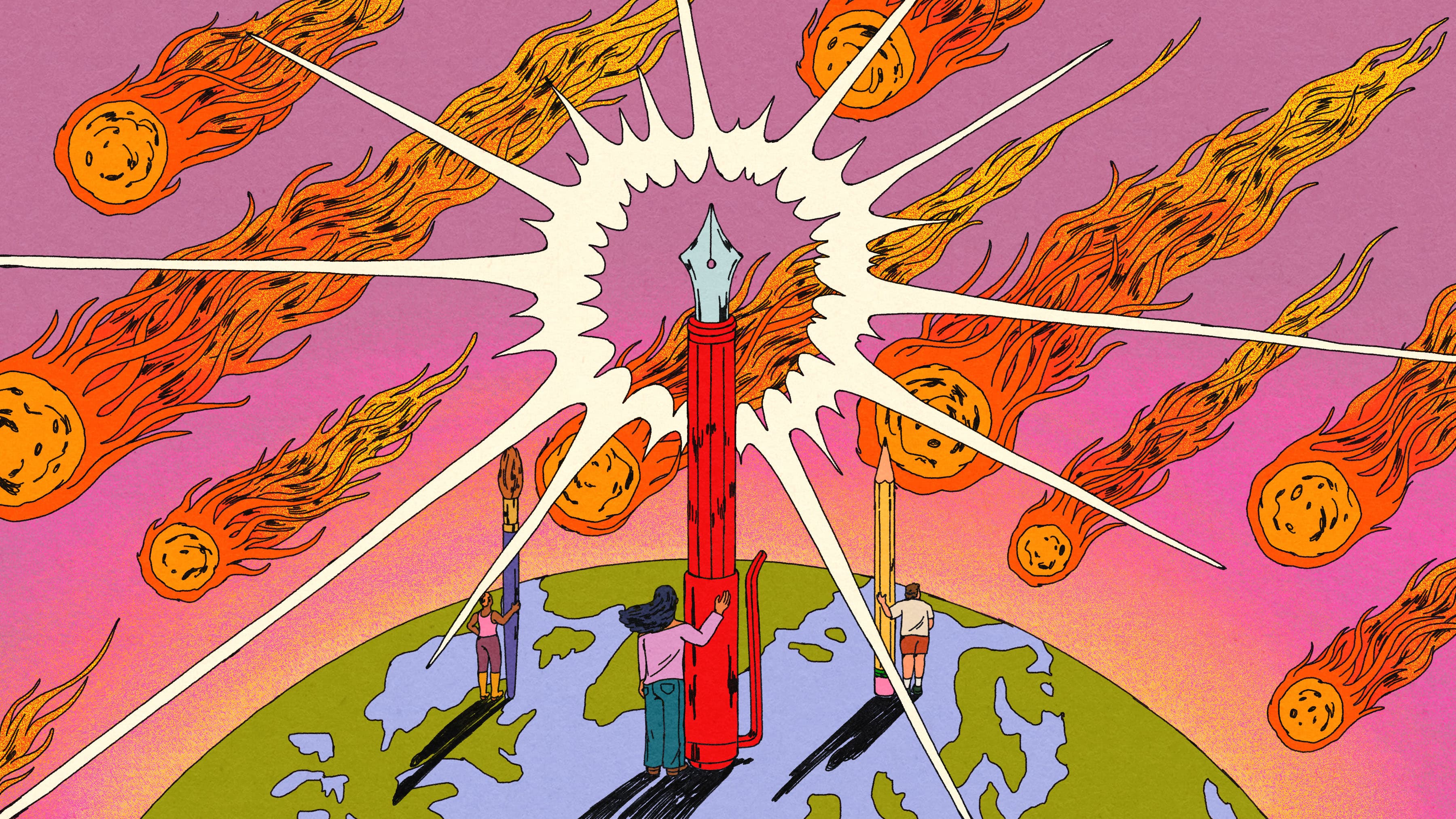
In nearly every exchange I’ve had with various artists this year, one question has shown up pretty consistently: “How do I stay creative when it feels like the world is falling apart?” And man, it’s a tough one.
I don’t think I need to get too granular about all of the destruction and political turmoil that’s been plaguing our world in recent days. You know what I’m talking about. And while human civilization has seen some turbulent times in centuries past, all of the negativity, fear, and egomania is now in our faces constantly via our social media feeds, a 24-hour news cycle, and for many, disruptions to daily life. It certainly takes an emotional toll so it’s no wonder that the question of how to persist as a creative person comes up in conversation so frequently these days.
A very personal question like this one deserves a very personal answer so before I get too into the weeds, two big disclaimers:
- I can’t answer this question for you specifically, reader. But I can speak to my own experience (everyone is creative, even me!) and share a few of the perspectives I’ve had the pleasure of receiving in recent conversations with working artists.
- Burnout, exhaustion, anxiety, meaninglessness, and despair are real feelings that should be taken seriously. If you’re experiencing any of these feelings, you deserve to be heard and supported by a mental health professional. Additionally, if you’re facing a crisis, help is available. In Australia: Lifeline 13 11 14; in the UK: Samaritans 116 123988; in the USA: call or text 988. You are not alone and this will not last forever.
In this article, I’ll walk through a few suggestions for finding moments of creative joy and bolstering your resilience, but first, let’s get abstract for a moment and reflect on the source of our creativity. Because before we go reigniting the flame of inspiration, we need to remember what sparked it in the first place, right?
Be your (innately creative) self.
If we reeeeally simplify it, creativity is just the act of imagining a different world than the one we live in. And that? We do that all the time. The late John O’Donahue put it so succinctly in an interview with Krista Tippet on her podcast On Being in 2008: “Everyone is involved, whether they like it or not, in the construction of their world. So it’s never as given as it actually looks; you’re always shaping it and building it. And I feel that from that perspective, that each of us is an artist […] Every night, when we sleep, we dream. And a dream is a sophisticated, imaginative text full of figures and drama that we send to ourselves. So I believe that deep in the heart of each of us, there is this imagining, imaginal capacity that we have.” TLDR; you’re crushing life as a creative person, even when you’re sleeping.
In my conversation with Timba Smits, a Melbourne-based artist, Timba shared his belief that the term “creative burnout” is misleading. Timba maintains that, in fact, it’s everything outside of our creative practice that gets in the way of imagination and makes us feel dysregulated. In his words, “I don't think that artists and creative people actually can get burnt out by what they love doing. If you look back to when we're all kids, we just loved to play, draw and imagine new worlds, right? Those creative acts made us feel happy. As grown adult artists, that's in a lot of ways how we still approach what we do. That’s what gives us energy and purpose. So burnout, I believe is really an unregulated nervous system disguised as burnout from the work. The burnout is coming from a lot of the negative influences and pressures that are happening around us.”
I can’t help but agree. While social unrest, economic uncertainty, and the harsh demands of the real world around us might leave us feeling exhausted, drained, and uninspired at times, no external force is strong enough to snuff out a genuine creative spark.
All of this is to say: creativity is innate. When it feels like the world is falling apart around us, we can step back, slow down, and give ourselves grace in small ways. There is energy and inspiration to be found in being curious, doing purposeful work, spending time in community, and taking our foot off the gas when we can. More on this below!
Make room for curiosity and creative joy.
In a world that demands and incentivizes productivity and growth, I know that the advice to “show up” sounds a bit rich but hear me out: if you feel drained, down, or absolutely frazzled, showing up in a way that’s intentionally unproductive can be restorative.
A handful of artists that I’ve spoken with recently, including New Jersey-based illustrator Kaitlin Brito, experiment with physical art forms outside of their primary commercial medium as a way to find creative joy and ground themselves. As communication and work increasingly moves into digital spaces and programs, it can be refreshing to explore physical art forms like sculpting, fiber craft, songwriting, up-cycling, floral arranging, or long-form creative writing. Kaitlin shared, “A lot of my day to day is spent working very carefully with a stylus in hand, and my face in front of a screen. So, when those usual tools are removed from my desk, suddenly the pressure is off, and it feels like I can do anything. Lately it's been mediums that require me to get messy, like sculpting air dry clay miniatures!"
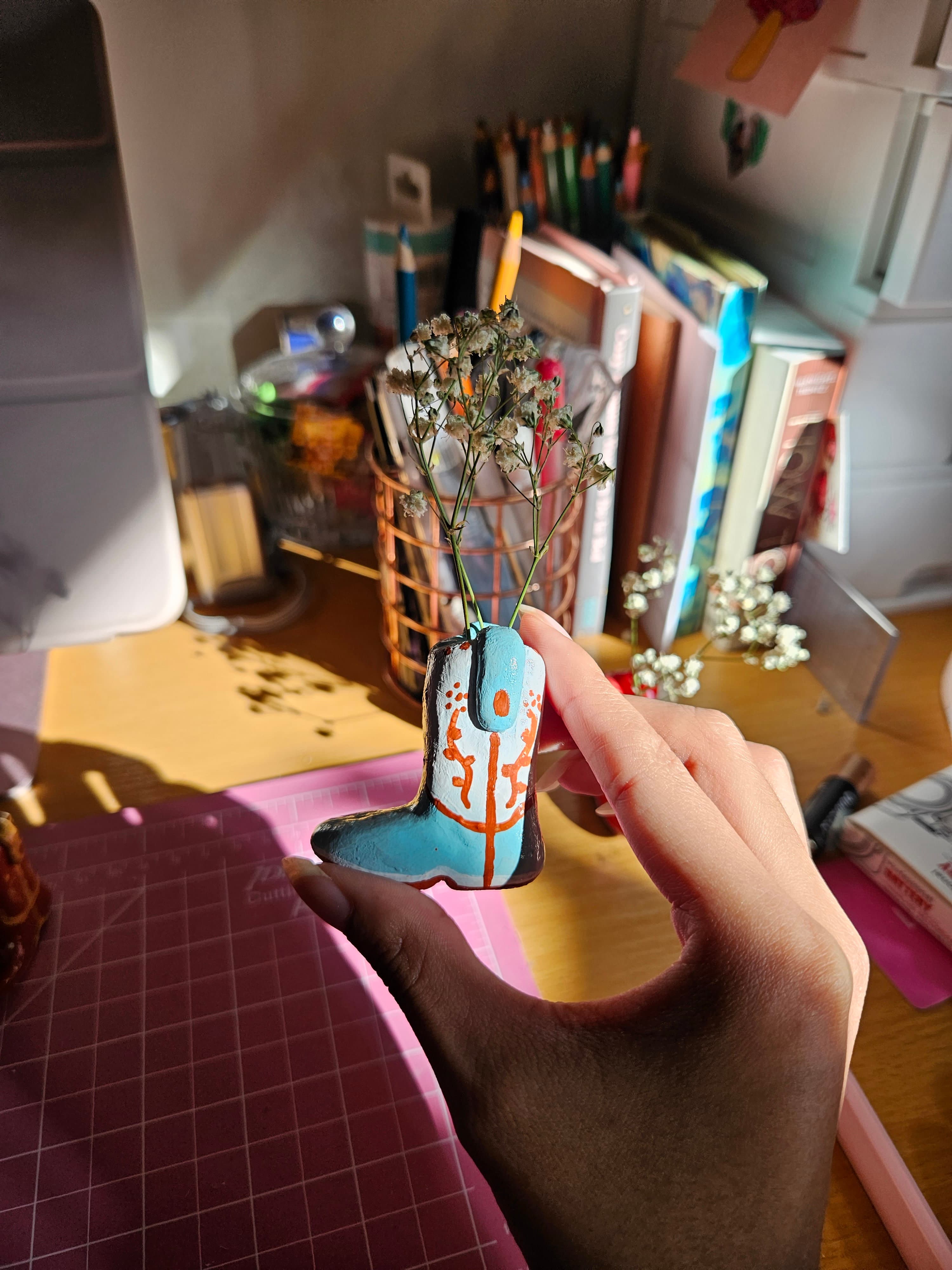
As someone who serially goes overboard with supplies when experimenting with a new medium, you can trust me when I say that simple and minimal is good. A few ideas: invent a new character with modeling clay, explore color stories by weaving or sewing scrap yarn to paper, or spend 15 minutes writing a short story based on a piece of art that you admire.
Or, borrow from a well-known technique in the art therapy world and give repetitive mark-making a try. If you’re up for it, find a quiet space, a drawing surface, and a mark making tool. It’s pretty self-explanatory from there: create a mark and repeat the mark over and over again for at least ten minutes with the intention of tuning into your physical presence and movement. If you get distracted or your mind starts to wander, do your best to turn your attention back to the activity and be mindful about what’s happening in front of you.
When it feels like your spark is currently shrouded in fog, take a moment to recall the sense of joy or curiosity that you felt when you allowed the power of imagination to guide your creations without letting rules or self-censorship get in the way. What was the activity or experience that called you to a creative career? When I was a preteen, I would hide away in my bedroom for hours and collage teeny tiny boxes with teeny tiny shreds of paper, magazines, and other ephemera (very uncool behavior for a middle schooler). I recently busted out my box of paper clippings with the intention of collaging a little paper bag that I saved from apple picking years ago and was pleasantly surprised by how easily I fell back into the rhythm and joy of creating for myself.
The key with any of these activities is to take the pressure off and reconnect with the creative part of you that got into making art because you loved to explore and express yourself. Add an hour or two of plain fun into your weekly practice if it’s not there already.
Talk about what you’re feeling and seeing.
I’d also encourage artists who feel weighed down by the current state of the world to ask: is there a place in my practice to talk about what I’m feeling and seeing? Art is a powerful tool for expression, dissent, documentation, and the imagination of a different future. While I know that not everyone has the privilege and safety to do so, I have a lot of respect for artists who have the courage to use their voices and uplift causes they believe in.
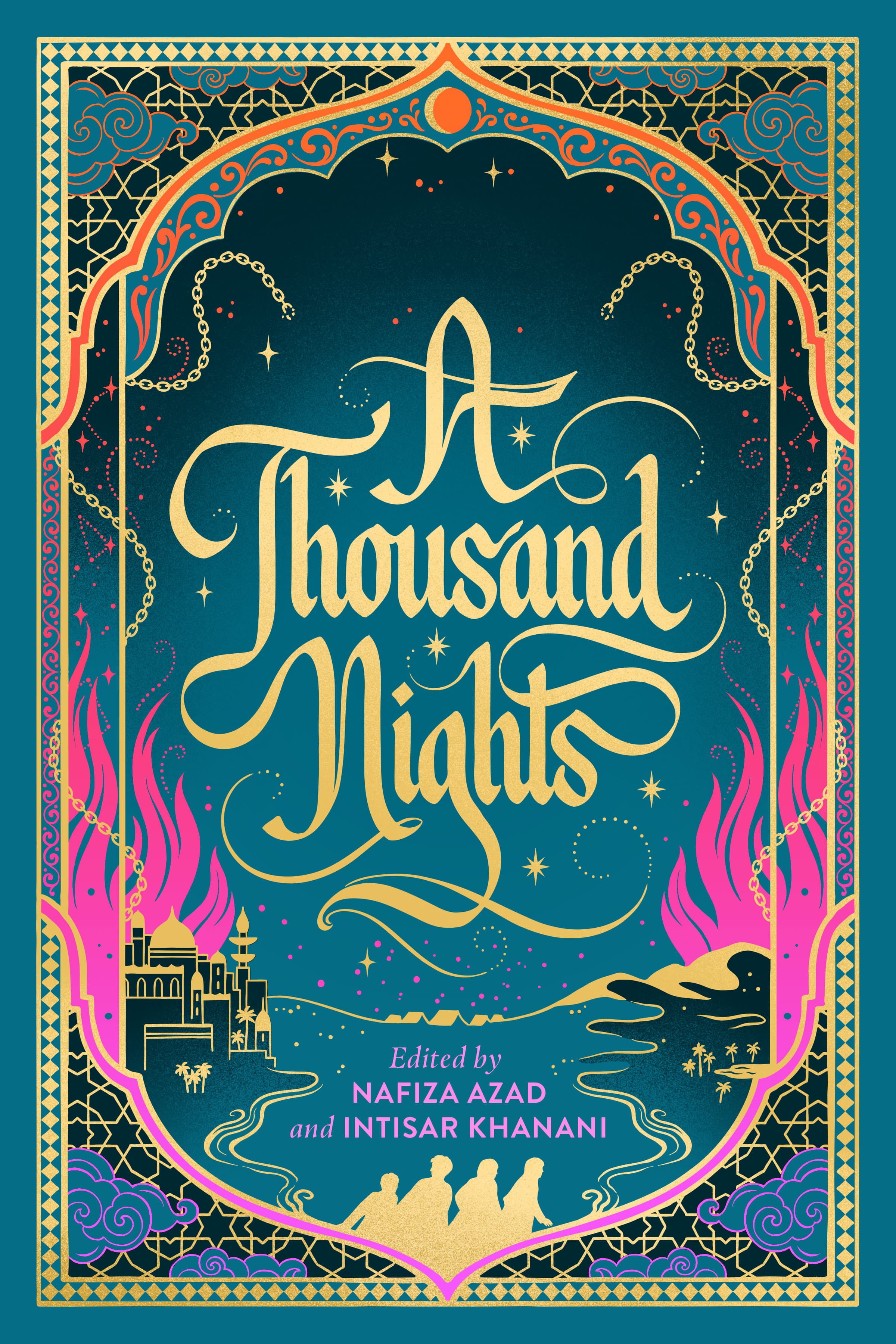
In my correspondence with artist Jessica Cruickshank, Jessica shared her perspective on the double-edged sword that comes with sharing inherently political viewpoints and artwork publicly. On one hand, she understands why some artists hesitate to share their opinions online for fear of losing out on certain commercial opportunities. But, on the flip side, Jessica maintains the perspective that expressing those opinions can actually open you up to more opportunities that are aligned with your values. She believes that through her advocacy, specifically around Palestine, she happened to attract a new audience and land one of her favorite commissions to date: a cover illustration for the YA anthology A Thousand Nights.
Aside from paid commissions, there are also opportunities to invest time, energy, and artwork to issues that feel important to you. Carlos Oliveras Colom, a visual designer, lettering artist, and illustrator from Puerto Rico who is currently based in New York, often creates work that captures his unique viewpoints and perspective. Carlos hopes that by creating art that reflects his personal POV, he’ll resonate with people on a more authentic, human level and inspire other artists from traditionally underrepresented backgrounds to share their unique perspectives with the world too. But, he noted that putting yourself and your opinions into your work does require some level of acceptance that you can’t control how people will react. Artists should be prepared for critical feedback, though the pendulum can swing in the other direction. In Carlos’s words, “It's very hard to curate how people are gonna feel about something and who is gonna react to it. I feel like you just have to make it and put it into the world and see how the world takes it. [You might be] super surprised that people are interested in it more than you expected.”
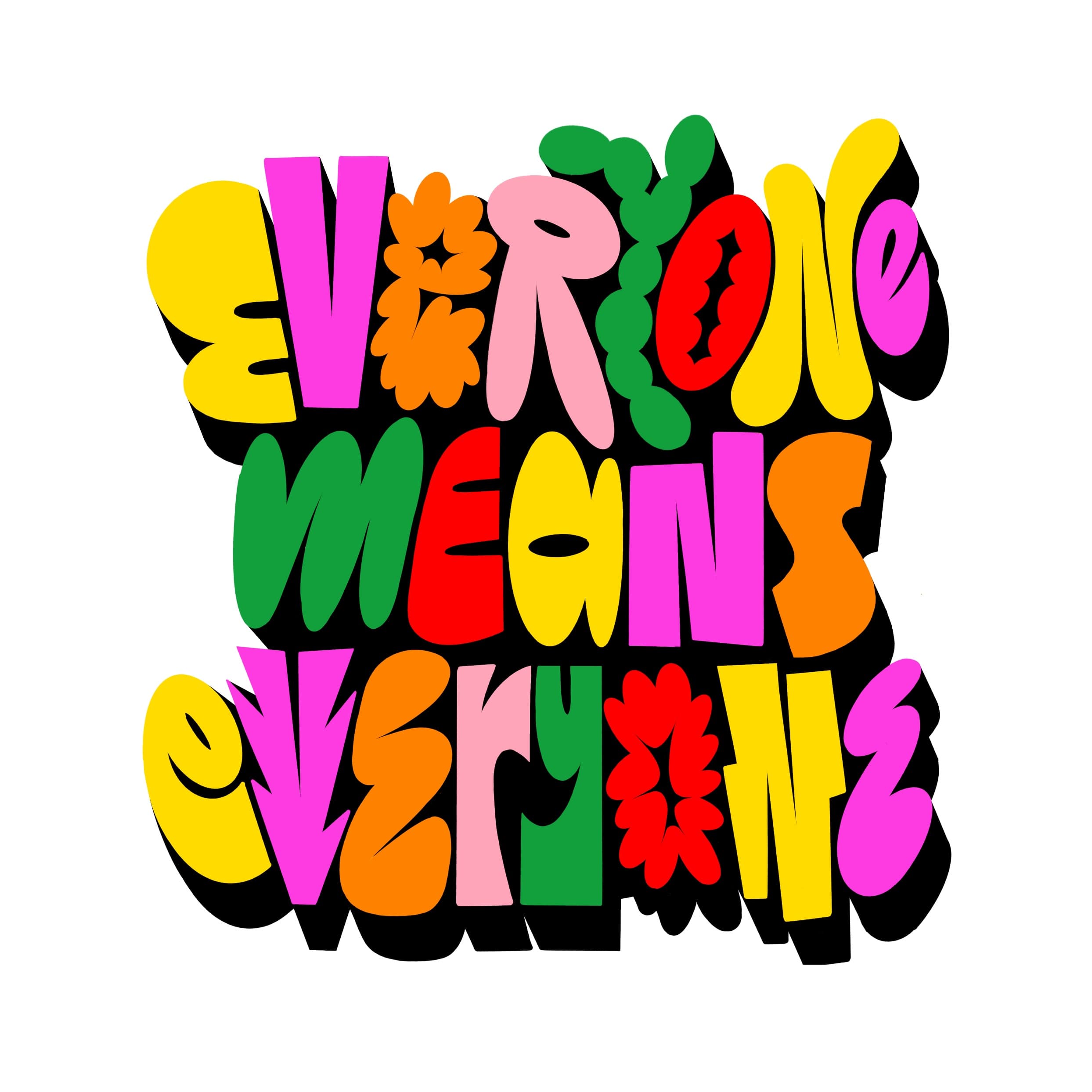
I want to be clear that I’m not advising artists to create or share anything that makes them uncomfortable in order to attract new work, but in a world that increasingly makes us feel fearful of speaking up for what we believe in, there is a case to be made for being true to yourself and proactively seeking out collaborations that fill your cup.
Plug into your community.
As we all know, feelings of fear and despair thrive in isolation. With that in mind, another way to keep our spirits lifted and reconnect with our own creativity is to plug into our local communities and other shared digital spaces.
While many artists see social media as a necessary evil, Carlos is incredibly grateful for the community that it opens him up to. He shared, “I'm thankful for social media in a way. Because of it, I've gotten to meet a lot of cool people and cool artists around the world which has been super fun. [...] Once upon a time, I was insecure about my work. But the community on social media motivated me to make more work. And some of the work that I do transcends language barriers, so a lot of people can interact with it.” Keeping up with the algorithm can be incredibly taxing at times so I appreciate this optimistic lens.
If you’re not sure where to start, there are tons of global organizations and local spaces that are incredibly welcoming and open to creatives seeking community. Here are just a few of the many fabulous groups and events carving out spaces either in-person and online for creative people:
- —•CreativeMornings
- —•Creative Lunch Club
- —•The Association of Illustrators
- —•Society of Illustrators
- —•Nicer Tuesdays hosted by It’s Nice That
- —•Your local art gallery (shoutout to the wonderful Jacky Winter Gallery in Melbourne!)
Take a time out when you need one.
Then of course, you can always do nothing… at least for a little while. Sustaining a commercial art practice can often see artists working long hours to make a deadline, sitting in the same spot for hours on end, and spending lots of time in front of a computer so it’s important to incorporate rest into your routine.
Timba is keenly aware of the way that his daily practice affects his body. To get ahead of potential exhaustion, Timba prioritizes short breaks every 45 minutes which he fills with a few minutes of walking, dance, or an activity that refreshes his creative spark like reading. Preventative actions and boundaries can go a long way in building resilience and creating a routine that feels sustainable. But then of course, there are times when the situation calls for a deeper form of rest, Timba shared, “exhaustion and overwhelm can sometimes be relieved through physical exercise [and] movement, like a walk to help us reconnect to our body. But then sometimes, it requires regular breaks, rest and sleep, or as I like to call it, the art of doing nothing.” And hey, I’m not going to argue with anyone who says that we should be napping more :)
As a reminder, you’re creative whether or not you’re productive. It’s okay to rest, recharge, reconnect, and even dance in service of your practice.
Trust that we’ll get through this together.
I recognize that many of the ideas and suggestions above assume that you have the safety, resources, and time to hop off the hamster wheel for a moment which I know is easier said than done. I understand that it takes immense effort to sustain a commercially successful artistic practice on top of life’s many other obligations.
I admire the people around me who squeeze explorations, experiments, and projects that fill their cup into the nooks and crevices of everyday life. The incredibly talented artists that I partner with in my role at Jacky Winter inspire me and keep me feeling optimistic that despite all of the destruction in the world, creativity and creative people will prevail. So if anyone needs me I’ll be at my desk, collaborating with wildly imaginative people, doing my best to support artists and their art, and holding onto hope that we’re going to get through this together. (Cheesy, I know, but I honestly believe it.)
Newsletter
About the author
A meticulous, caring and optimistic agent and producer, Aubrey balances the needs of each party with ease and makes any collaboration a positive one. Her specialties lie in animation, advertising, branding, packaging, installations, and events. With a degree in industrial design, she also has the vocabulary and know-how to expertly guide the product development process from start to finish.