Dear Jacky:
Which countries pay the most for illustration and how do I get a piece of it?
Insights from our international offices on how geography still shapes opportunity in a global creative industry.
Maybe it’s no surprise I felt at home at Jacky Winter straight away. Like me, the agency grew up in Melbourne before expanding abroad. Now that I’ve moved from Australia to London (groundbreaking) I’ve been able to experience firsthand the subtle and, on the flipside, quite stark differences that come with a change in location. With years of experience handling projects across continents, Jacky Winter has naturally and purposefully developed a deep understanding of the patterns, trends, and nuances that shape the creative world globally.
It’s easy to assume that all creative industries function similarly, especially in a world where we’re constantly online and feel more globally connected than ever. I definitely had my own assumptions pre-move. But working across different regions has shown me just how much geography still matters, influencing everything from communication styles and budgets to expectations and how artists are received within their local markets.
After recently returning from a trip home to Melbourne, where I had the pleasure of spending time at JWHQ, it felt like the perfect moment to look more closely at how the creative industry operates on a global scale, using insights from our three bases in Australia, the UK, and the US. Here we'll dig into what that means for artists working across global borders, from how you communicate with clients, to where the work is coming from, and what it actually pays.

I’ve just had a brief come through from abroad. What should I keep in mind before replying?
Communication styles are often the first place these regional differences show up. Knowing how clients like to communicate and what they prioritise can help artists match their energy, manage expectations, and protect their own boundaries. Seeing these trends through a global lens makes it easier to spot patterns, adapt where needed, and plan projects more strategically.
In the UK, I found a very warm and trusting professional environment from the outset. Video calls bring together clients, agencies, and artists and are by far the preferred method for productive briefings (always with a very pleasant and polite tone, as to be expected by such a well mannered nation). This lends itself to a collaborative and friendly vibe throughout the project and it’s always great to have a face to a name! I find jumping on calls whenever possible is the quickest way to gain rapport and strengthen any relationship.
That friendly tone carries across European projects, also handled by the London office. Projects in Europe often bring a real creative energy, with feedback that's highly collaborative, personal in its approach, and full of personality. It's a really distinct way of working that tends to produce some genuinely memorable creative relationships, and one of the things that makes the London office such an interesting hub to work from.
Back in Melbourne, briefs and emails can vary pretty widely, from super concise and clear all the way to more detailed and considered, but the one thing that really comes through consistently is that Australian clients place a lot of value on connection and relationship-building. Warm, friendly communication goes a long way here, and that ease tends to carry through the whole project. It's also worth knowing that by the time a brief lands in your inbox in this market, it's usually go time. There's often a hard deadline already attached and as the creative partner, you're typically coming in at the sharp end of that timeline. Rather than feeling daunting, it actually speaks to the level of trust clients place in the people they work with, and can make for some of the most straightforward and energising projects to be part of.
The Australian office also handles a significant volume of work across Asian markets, which makes a lot of sense given the timezone overlap. Communication in this space calls for a particular kind of care. Emails need to be clear and properly structured, and there's often a lot of reading between the lines involved. Video calls can be communicatively tricky but they do still help with building rapport, which goes a long way in making these projects run well. It's a really rewarding area of work that responds well to patience and attentiveness.
Meanwhile, in the US, the thing that really stands out is the layers of approval and hierarchy that often shape how projects move forward. Feedback frequently needs to travel through larger teams with a variety of voices in the room before anything gets signed off, which is worth factoring in from the outset. While fast-turnaround projects do come our way, it's not uncommon for a US client to come to us with a brief that looks ready to go only for it to get held up by internal sign-offs and the sheer number of stakeholders who need to weigh in. A brief that seems defined on day one can easily take two months to get over the line from first enquiry to project award. That said, when you're working with direct clients who have real autonomy and decision making power, the experience can be a lot more straightforward and the friction pretty minimal. Managing your energy across a longer lead time is definitely something to factor in, but the relationships that come out of that slower build tend to be really solid ones.
Across these regions, it’s clear that artists can’t assume one approach fits all. Understanding local communication styles is key to working successfully and building those important lasting connections across borders. While it’s always important to stay authentic in how you communicate, it’s just as valuable to remain adaptable. Making the client’s life easier wherever possible often benefits the working relationship as much as the creative output itself. Matching a client’s communication style can be a simple way to reflect their enthusiasm and show that you’re aligned from the outset. This might mean responding at a similar pace or sharing regular updates if they prefer a tight feedback loop. If a client has sent a really detailed brief, it's also worth matching that energy with a structured recap of the brief and next steps. Taking the time to confirm a shared understanding of the scope in writing is always recommended but especially helpful when working across borders, where expectations and working rhythms can differ more than expected.
Small adjustments in how you communicate can go a long way in building trust early and setting projects up to run more smoothly from the start. Take a moment to analyse the tone of the inquiry and use that as a starting point!
Get To The Juicy Part, How Do Budgets Differ by Market?
Looking at how budgets differ across our regions offers another interesting perspective on what you can expect from commissions globally. We've used our data from the past twelve months and looked for patterns in how commercial projects are priced. To give a more accurate picture of how these projects are sitting budget-wise across the regions, editorial commissions have been separated out here, as these operate in a similar way globally and often within constrained budget ranges. We'll dive into that briefly before refocusing on how our projects from the last year depict the differences between offices and the logic behind them.
Another interesting angle here is not just the size of the budgets, but how they're structured. These patterns can help you as an artist better align your expectations and ultimately make more informed decisions about how you may pitch your work internationally. It's also always worth considering how population size reflects what clients are able to invest in marketing and visuals. Larger audiences bring a larger expectation of reach for a campaign, and therefore of perceived value, which naturally shapes how illustration budgets are structured across the world. A national campaign in the US means a completely different audience size to a national campaign in Australia, and the budgets tend to reflect exactly that.
Editorial
The editorial market shows a reliable and consistent flow of work across all three of our offices and for artists building a varied practice, also providing a way to stay creatively invigorated between larger commercial projects. Editorial commissions often have the most freedom in conceptual work and make for great folio pieces, operating at a typically fast paced with a quick turnover of new briefs. If you're looking to lean more into editorial, you're opening yourself up to more regular enquiries, which is exactly what we see reflected across each of our offices.
One thing worth noting is that while typical editorial rates are broadly comparable across our three offices in real terms, the US does offer a higher ceiling with top tier publications commissioning at rates that are significantly above what you'd typically see elsewhere. It's worth factoring in if you're thinking about where to direct your more ambitious editorial pitching.
Now onto the commercial budgets...
Australia
Our Australian office accounts for the highest volume of commercial projects across the year by a pretty big margin. This is in part because that's where our roots are and where we've developed the most artist and client relationships, but it also indicates a genuinely diverse range of sectors and commissions, from an iconic food scene to government initiatives. It's a rich creative landscape, and the volume of enquiries we receive means artists have access to more frequent opportunities as well as more variation.
The commercial landscape here is pretty wide. A lot of commissions sit very comfortably in the $10K - $20K AUD range, with those bigger projects pushing up into the $30K - $50K territory. We've also had some standout campaign-level briefs that have reached significantly beyond that, but overall this sliding scale really represents the breadth of creative needs from clients in Australia. There's a consistent and healthy flow through that mid-range too, which creates a dependable and exciting stream of opportunity throughout the year for artists.
Volume and variety are the two major strengths here. Rather than being driven by a handful of really large clients, Australian opportunities are a lot more evenly distributed, both across industries and across artists, making this a really open and rewarding market to work across.
UK & Europe
Moving over to the UK and Europe, one really strong indicator of the reliability of projects here is the conversion rate from enquiry to sign-off. It suggests that clients in this region typically come to a conversation with a pretty clear understanding of scope and what will be required of the artist, and what's involved in getting it across the line. That confidence translates into a reliable and consistent pipeline of commercial work throughout the year.
The commercial budget range here spans from a solid mid-range of £20–£50K through to significant campaign-level briefs pushing over £100K. It's also worth noting that in GBP, those figures carry more weight internationally than the same number might elsewhere. A pound stretches further than many equivalent currencies, meaning UK commissions often represent greater real value than simply their numerical figure suggests, something worth factoring in when you're weighing up the true value of a project across borders!
The London office also handles a substantial volume of European work, often billed in Euros, which adds further reach and variety to the mix. More countries, more cultures, more distinct groups of audiences, all within a comparatively small land mass. That density naturally contributes to a really diverse and interesting range of opportunities, spanning many different industries from food and beverage to travel and hospitality, fashion, education, and a rich variety of cultural sectors amongst them.
United States
The United States market has the highest ceiling of all the regions budget-wise, and it's not really even a close call. Commercial illustration budgets here start quite reliably above the $30K USD mark for campaign-level work, and it's definitely not unusual to see briefs moving well into six figures for larger multi-channel rollouts across Entertainment, Technology, or for other major Consumer Brands.
It's worth considering why this is the case. The US is home to some of the largest companies in the world, but it's also just a much bigger country - over 330 million people, compared to around 26 million in Australia. The scale and reach expected from a nationwide campaign is a completely different proposition. Think of the scale of a Super Bowl campaign, that's the kind of reach US clients are building for, and budgets reflect exactly that! The kind of commission that might feel exceptional elsewhere is actually just a recurring part of the conversation here.
This is particularly true for returning clients, who tend to bring both trust and real ambition to a brief. A lot of the team's most rewarding projects come through those ongoing relationships, and a huge amount of credit goes to the US team who've worked incredibly hard at building and maintaining them with some really major American players.
Taken together these patterns show that budget expectations differ not just in size but also in how far those budgets can stretch once currency is taken into account. For artists working internationally, keeping exchange rates in mind can help contextualise opportunities and understand where time and effort may go the furthest, without neglecting the importance of local markets, which continue to generate the majority of an individual artist’s work.
Payment platforms can also make a practical difference to how far project budgets stretch once converted. Services such as Wise or Veem are commonly used to reduce transfer fees and manage currency exchange more efficiently, helping artists retain more of the value of currency converted commissions.
So, Where Exactly Are All The Opportunities Coming From?
Looking at where work originates is another handy way to understand how our markets operate. Over the past 12 months, patterns have emerged in not only which industries are commissioning work, but in how concentrated, or diversified, those opportunities are across all our offices…
Publishing is a different lens entirely and one that’s worth taking a look at. Publishing opportunities tend to be longer, more structured, and able to grow over time. Book advances are paid in instalments across the life of a project, royalties continue to come in well after delivery, and a strong publishing relationship can generate opportunities across multiple titles and editions. It's a slower burn, but one that can build in a really meaningful way!
Publishing holds a strong presence in our global mix, strengthened all the more by our not so new literary agency, Gildlings, In Australia, commissions are spread pretty evenly across a wide range of industries, with Government, Food & Beverage, Retail, Property & Infrastructure, and Education all sitting within a few percentage points of each other at the top of the leaderboard. Rather than being driven by one dominant sector, the Australian market reflects a genuinely diverse creative landscape where opportunity is distributed across many industries and artists.
The UK market shows a smaller overall volume and a different industry mix. While Publishing remains a leading category, work is also strongly represented across News and Politics, Food and Beverage, Education, Travel and Hospitality, and Fashion and Beauty. As a hub for European projects, the London office handles work across a wide range of sectors, reflecting both the regional diversity discussed and a more editorially weighted landscape.
In contrast, the US market is more clearly concentrated by certain industries. Entertainment accounts for the largest share of projects by a significant margin, followed by Technology and Software, Publishing, and Consumer Goods. This distribution strengthens the idea that the market is led by fewer industries, operating at a higher scale, with many of the team’s new projects coming through returning clients and generally larger campaign based commissions.
Across all three regions, direct clients consistently account for a greater share of projects than agencies. While the difference is less pronounced in the UK, it widens in both Australia and the US, highlighting how important it is to put in the time and effort for those direct client relationships, considering the evolving way that creative work is being commissioned globally.
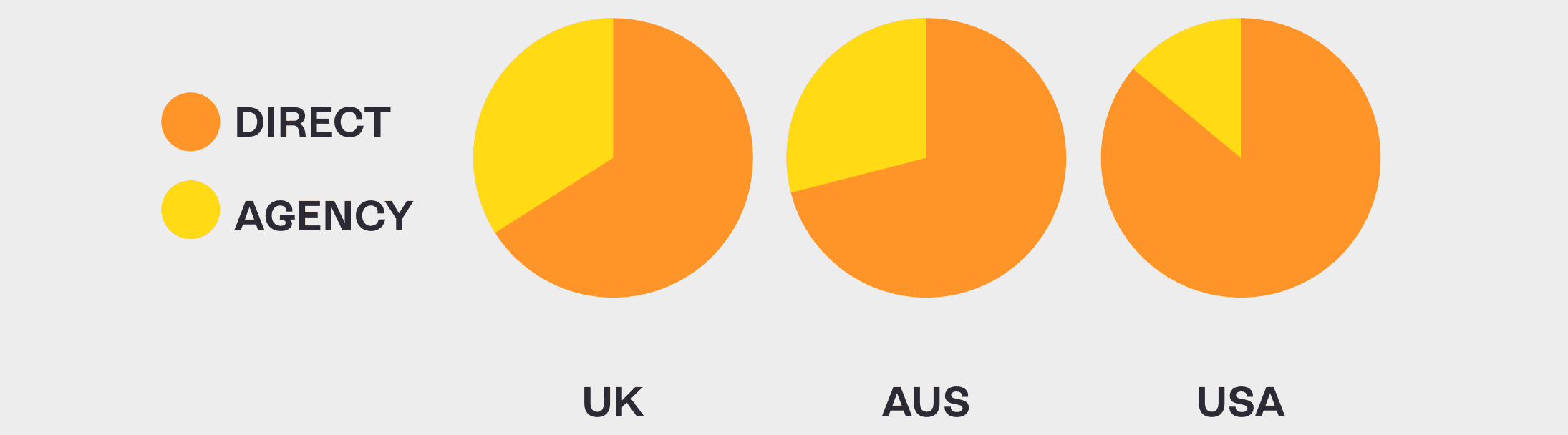
Taken together, these patterns highlight how different industries continue to drive opportunity in each region, even as creative work moves more freely across borders.
For artists looking to work more strategically across regions, paying attention to which industries are most actively commissioning illustration can be a useful starting point. Building familiarity with the visual language of the sectors you’re looking to work in can make outreach feel more focused and realistic. Even simple steps, like following art directors in those spaces or keeping track of recurring clients commissioning illustration internationally, can help clarify where your work naturally fits!
Alongside industry differences, visual style also plays a significant role in how opportunities vary between regions. Cultural references, advertising trends, and audience tastes all influence the kinds of illustration being commissioned locally, often in ways that aren’t immediately obvious from outside that market. It’s a huge topic on its own, and one we’re keen to explore further in a future Dear Jacky article! But for now, our weekly blog, Out of Commission, is a great place to keep tabs on a fresh selection of globally commissioned illustration and animation.
How Exactly Should I Position Myself From The Local To The Global Market?
Spending time across different global markets has shown me just how differently opportunities can take shape depending on where you're based. Even in a global industry, I repeatedly see how local visibility and community remain central to how artists build and sustain their careers over time.
Local visibility definitely remains incredibly powerful! Online engagement tends to travel shortest distances, shaped by algorithms, time zones, cultural context, and familiarity. For artists who relocate, this can sometimes be felt pretty quickly. An established presence in one region doesn’t always translate seamlessly to another. In many cases, building momentum again means reconnecting with local communities and allowing time for relationships to form. Global reach doesn’t replace local relevance and to see the most rewarding outcomes, the two often work best hand in hand.

Kelly Llanos, Jacky Winter Artist"Coming back to Colombia as an illustrator has been quite a journey. Since I moved back, I’ve been trying to really get involved in the local scene by going to big creative events, small workshops, and just showing up. Through that, I’ve discovered a unique energy that even inspired me to learn something new and so I started jewelry classes! I found a community that is all about warmth and people truly helping each other out. It’s a two-way street because I love sharing what I’ve learned to help younger artists see that you can actually make a living from illustration, but at the same time, I’m being recharged by their fresh perspectives and that contagious spark."
In saying this, as we’ve seen over the last few decades of Jacky Winter, it has also grown increasingly valuable to stay connected to international work and local conversations, which can offer important context for artists thinking about where their work sits beyond their immediate market.
There’s also value in simply paying attention to what’s happening past your personal horizons. Keeping an eye on overseas brands, agencies, and studios doing the kind of work you admire, can be a low-pressure way to understand how your dream creative jobs could differ across regions. That awareness can quietly shape how you may choose to position yourself. Practically speaking, positioning yourself across markets doesn’t always mean actively pursuing international clients straight away. It can start with smaller steps such as sharing work in spaces where international art directors are already looking or staying aware of how your style connects to trends outside your region. Over time, putting out these feelers can help build visibility beyond a single market without deflecting from the importance of you home base.
At the same time, working internationally doesn’t require being everywhere at once. Different markets reward different strengths, and not every region will align with every practice. We’ve seen that artists who thrive across borders are often those who are intentional about where their work sits, rather than those trying to appeal universally. Global work isn’t about scale for its own sake, rather about fit!
How can I apply these insights to my own personal practice?
Ultimately, navigating global opportunities isn’t about choosing between local and international work, but recognising how they can work with one another. If you’re thinking about working across borders, the most beneficial paths often come from balancing a strong sense of place with an openness to what’s happening elsewhere. Breaking down some of the insights from above into manageable steps could look like:
- —•Paying attention to which industries commission illustration most frequently in your target markets
- —•Adapting communication style to match client expectations across regions
- —•Keeping an eye on campaign trends internationally
- —•Factoring exchange rates and payment methods into how you evaluate opportunities
- —•Staying connected to and engaging with your local creative community whilst you build visibility abroad
Incorporating these into your flow could help you to look beyond your immediate network and make more confident decisions about how you position your work!
In a global industry that’s more connected than ever, geography naturally still shapes opportunity, but there are progressively more ways for you to move between markets if you’re being guided by strategy and intention!
All figures referenced in this article are drawn from Jacky Winter's internal project data, covering Q2 2025 through Q1 2026.
Newsletter
About the author
With a degree in interior design and a background in both TV and photography production, Emma is well-versed in the challenges that any creative project may present. Emma loves combining her creative eye with the project management skills she has developed throughout her career to achieve great (and aesthetically pleasing) results.